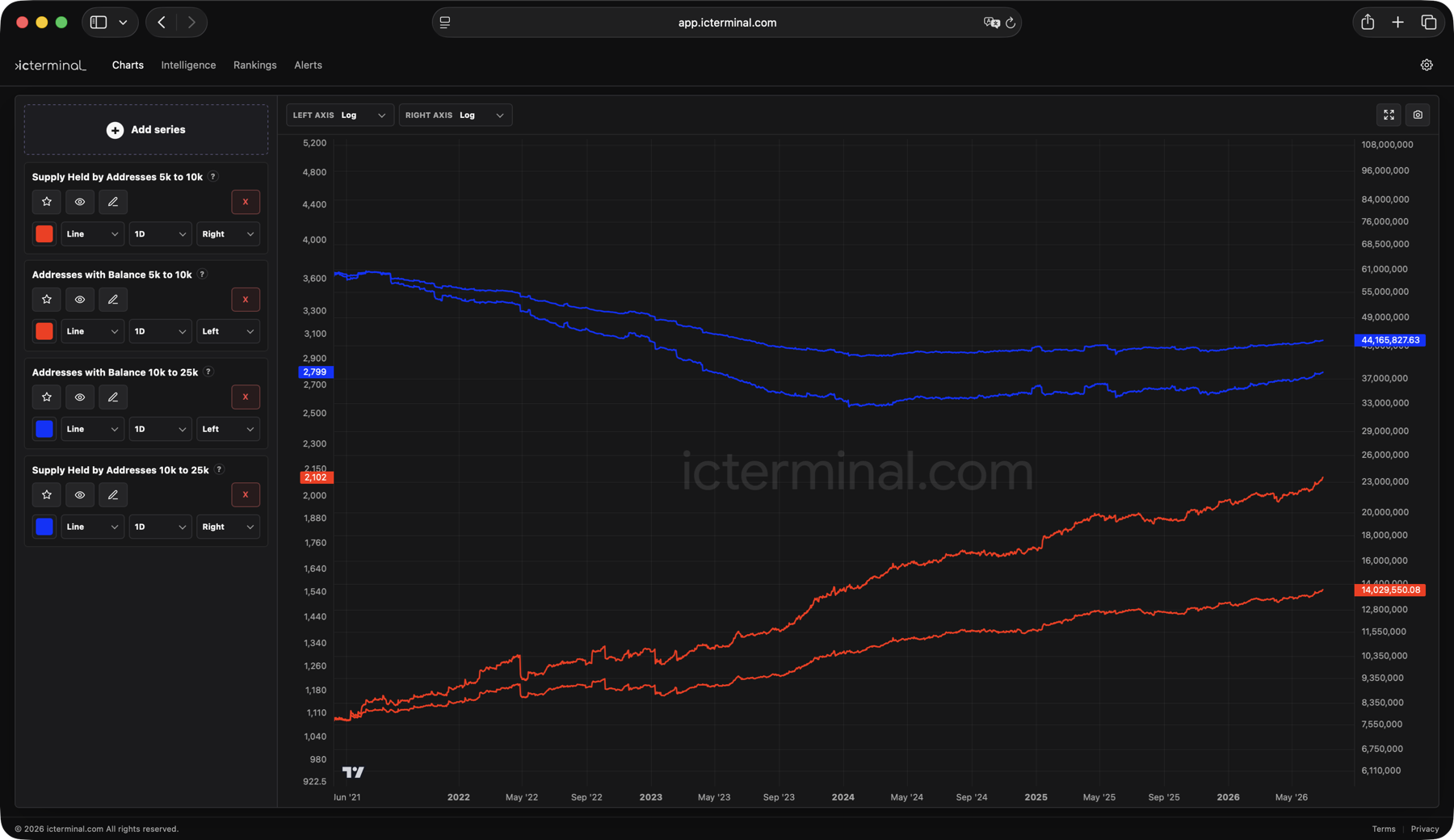
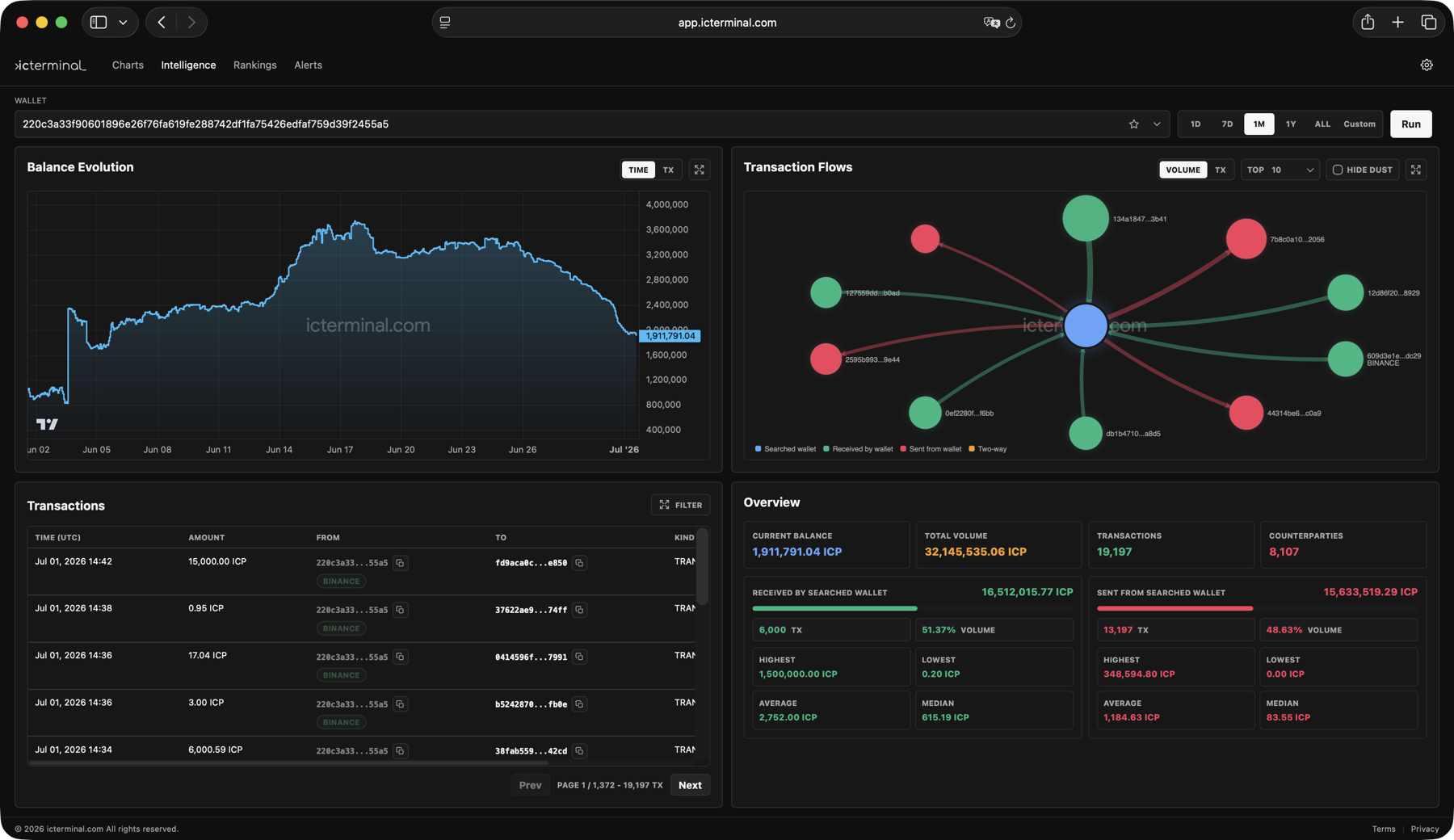
Supply Held by Fish (500-1k ICP)


Supply Held by Fish (500–1,000 ICP) measures the total amount of ICP held by all addresses with balances between 500 and 1,000 ICP. This tier represents the segment where holdings begin to resemble clear retail positioning with economic relevance. Wallets in this category often reflect early committed participants, structured retail allocations, or operational entities managing moderate balances rather than micro or incidental amounts.

How it’s calculated

All addresses with at least 500 ICP and less than 1,000 ICP are aggregated, and the combined balance of those wallets is presented as the metric output. Each address is counted once based on current balance, independent of activity frequency, source of funds, or transactional behavior.

What this metric highlights

This tier reflects the point where smaller participants begin to form noticeably meaningful ownership shares, offering context on the progression of supply dispersion across the retail layer:

  • Increasing supply held may suggest that more participants are accumulating into mid-sized retail ranges or transitioning upward from lower tiers.
  • Stable supply held implies that this segment is maintaining its position within the distribution structure without major inflows or exits.
  • Declining supply held could indicate upward migration to larger tiers, consolidation into fewer addresses, or distribution.

Limitations

For accurate interpretation, it’s important to consider the metric’s scope and boundaries:

  • Not indicative of market intent: Holding size alone does not imply accumulation, distribution, or sentiment changes.
  • Mixed address profiles: Wallets may belong to individuals, services, custody structures, staking entities, or dApp-related operations — identity remains unknown.
  • Movement is non-directional: A transition into or out of this bracket does not automatically reflect bullish or bearish positioning.

Disclaimer: The information provided in the descriptions above is for informational and educational purposes only and is intended as a general overview of the referenced metrics. These descriptions are illustrative, descriptive, and non-exhaustive; additional interpretations, use cases, and limitations may exist that are not covered here. Nothing herein should be construed as financial, investment, legal, tax, or professional advice, nor should it be relied upon as the sole basis for any decision-making process. All users should conduct their own independent research, validate data through multiple sources, and consult with qualified professionals where appropriate. The content provided does not guarantee accuracy, completeness, or reliability, and no representation or warranty is made regarding its correctness. The metrics, interpretations, and examples mentioned are subject to change over time and may not reflect all possible scenarios or market conditions. By using this information, you acknowledge that you do so at your own discretion and responsibility. No advisory, fiduciary, or client relationship is created through the use or reading of this material.