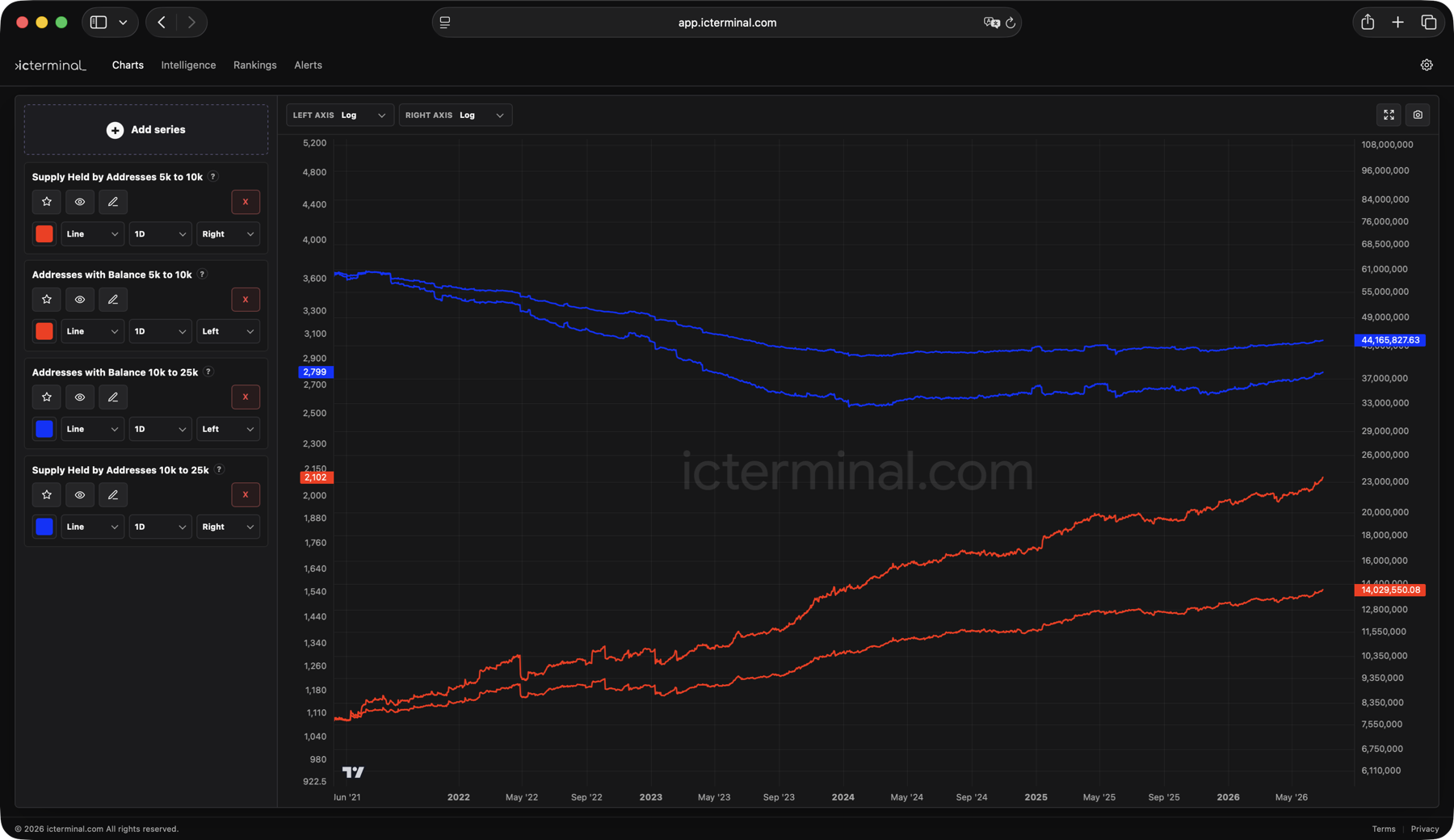
Number of Whale (10k-100k ICP)


The Number of Whale (10,000–100,000 ICP) metric measures how many ICP addresses hold balances within the 10k to 100k ICP range. This tier typically represents professional holders, high-net-worth participants, and in some cases institutional or exchange-related wallets. Balances at this level indicate a materially significant position with the potential to influence liquidity, market dynamics, and supply concentration.

How it’s calculated

Addresses are classified based on their current balance. Any address holding at least 10,000 ICP but less than 100,000 ICP is included. Each address is counted once per measurement period, regardless of trading frequency, transaction size, or whether the address is actively used.

What this metric highlights

The Number of Whale metric is often used to observe how professional or semi-institutional presence evolves over time. Changes in this tier may reflect shifts in strategic accumulation, reserve management, or custodial activity:

  • Increasing whale count: Can indicate growing representation of larger, more committed capital, strategic onboarding of higher-value participants, or new custodial/exchange wallets entering the system.
  • Stable whale count: Suggests continuity in large-balance participation, without major distributions or new growth in high-value custody.
  • Declining whale count: May point to consolidation into even larger tiers, redistribution to smaller holders.

Whale-tier wallets often sit at the center of supply concentration, making this metric a relevant observation point in the broader landscape of ownership structure.

Limitations

While informative, the Number of Whale has boundaries worth acknowledging:

  • Identity is unknown: The metric cannot confirm whether a wallet is a professional individual, institution, exchange, or automated custodial address.
  • Activity is not reflected: A wallet may be inactive, strategic, or functioning as a cold storage address rather than engaging in active on-chain behavior.
  • Not a direct market signal: A change in whale count does not inherently imply buying, selling, accumulation, or distribution — it only reflects the number of addresses in the range.

Disclaimer: The information provided in the descriptions above is for informational and educational purposes only and is intended as a general overview of the referenced metrics. These descriptions are illustrative, descriptive, and non-exhaustive; additional interpretations, use cases, and limitations may exist that are not covered here. Nothing herein should be construed as financial, investment, legal, tax, or professional advice, nor should it be relied upon as the sole basis for any decision-making process. All users should conduct their own independent research, validate data through multiple sources, and consult with qualified professionals where appropriate. The content provided does not guarantee accuracy, completeness, or reliability, and no representation or warranty is made regarding its correctness. The metrics, interpretations, and examples mentioned are subject to change over time and may not reflect all possible scenarios or market conditions. By using this information, you acknowledge that you do so at your own discretion and responsibility. No advisory, fiduciary, or client relationship is created through the use or reading of this material.