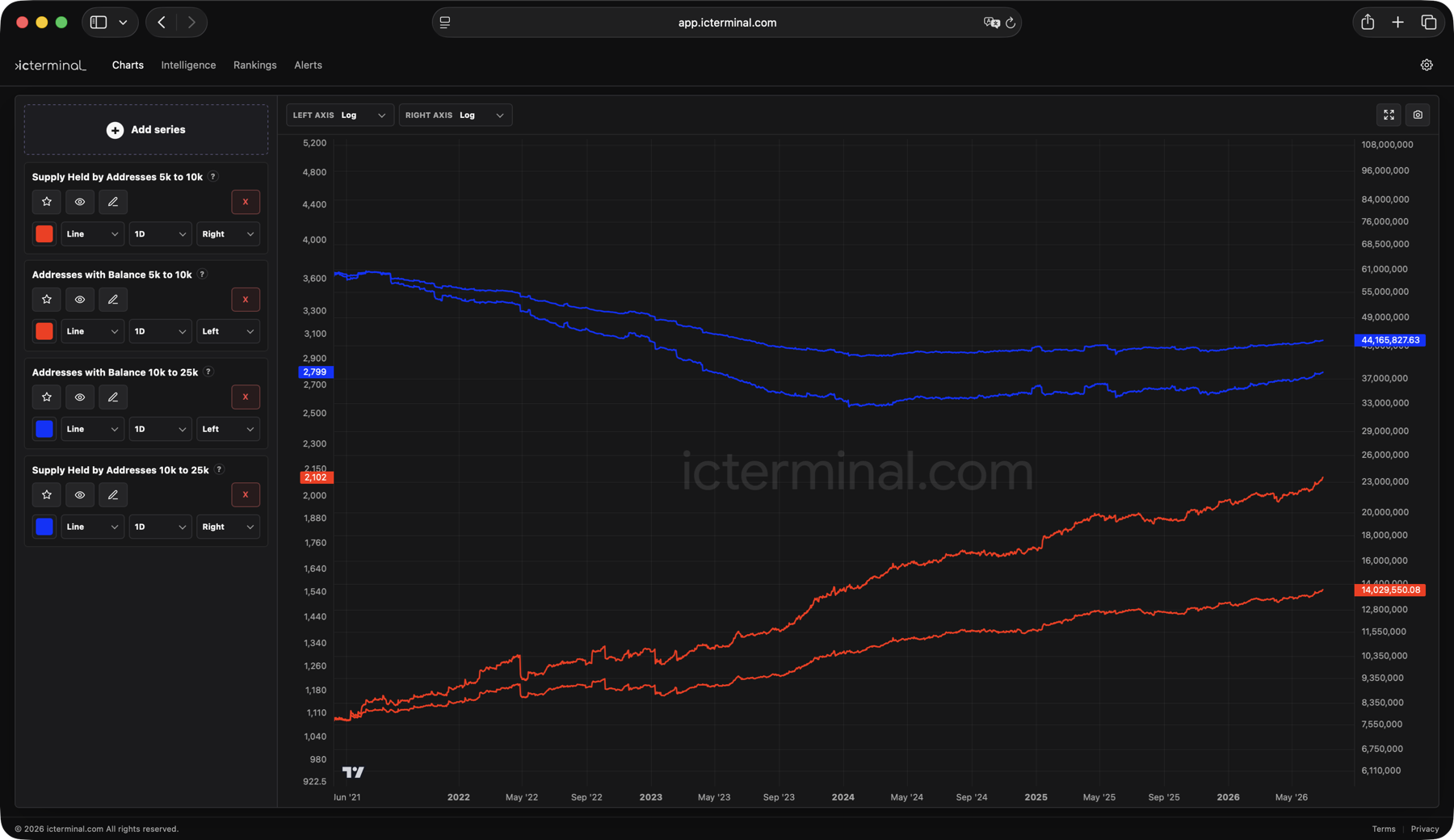
Number of Shark (5k-10k ICP)


The Number of Shark (5,000–10,000 ICP) metric counts the total number of ICP addresses holding between 5,000 and 10,000 ICP. Addresses in this tier typically represent medium to large retail participants or small professional holders, reflecting economically significant stakes capable of impactful transactions and accumulation on the network.

How it’s calculated

All addresses are analyzed based on their current ICP balance. Addresses holding at least 5,000 ICP but less than 10,000 ICP are included in this category. Each address is counted once per period.

Interpretation of trends

The Number of Shark provides insight into more substantial retail and semi-professional accumulation:

  • Increasing Shark count: Suggests growth in medium-to-large retail participation, as well as new accumulation by small professional holders. This may indicate confidence in the network, strategic accumulation, or operational usage at a higher balance level.
  • Stable Shark count: Reflects a consistent number of economically significant addresses, suggesting stability in this tier without major consolidation or expansion.
  • Declining Shark count: Could indicate aggregation of balances into larger wallets, or reduced retention among medium-to-large holders.

Limitations

Although the Number of Shark provides valuable insights into medium-to-large retail and small professional holdings, it has several limitations:

  • Partial economic representation: Balances are significant for retail and small professional holders but still smaller than whale addresses.
  • Activity not guaranteed: Shark addresses may be dormant, operational, or used intermittently for staking, transfers, or testing.
  • Automated or operational addresses: Some addresses may belong to canisters, scripts, or protocol-level operations rather than individual retail or professional users.

Disclaimer: The information provided in the descriptions above is for informational and educational purposes only and is intended as a general overview of the referenced metrics. These descriptions are illustrative, descriptive, and non-exhaustive; additional interpretations, use cases, and limitations may exist that are not covered here. Nothing herein should be construed as financial, investment, legal, tax, or professional advice, nor should it be relied upon as the sole basis for any decision-making process. All users should conduct their own independent research, validate data through multiple sources, and consult with qualified professionals where appropriate. The content provided does not guarantee accuracy, completeness, or reliability, and no representation or warranty is made regarding its correctness. The metrics, interpretations, and examples mentioned are subject to change over time and may not reflect all possible scenarios or market conditions. By using this information, you acknowledge that you do so at your own discretion and responsibility. No advisory, fiduciary, or client relationship is created through the use or reading of this material.